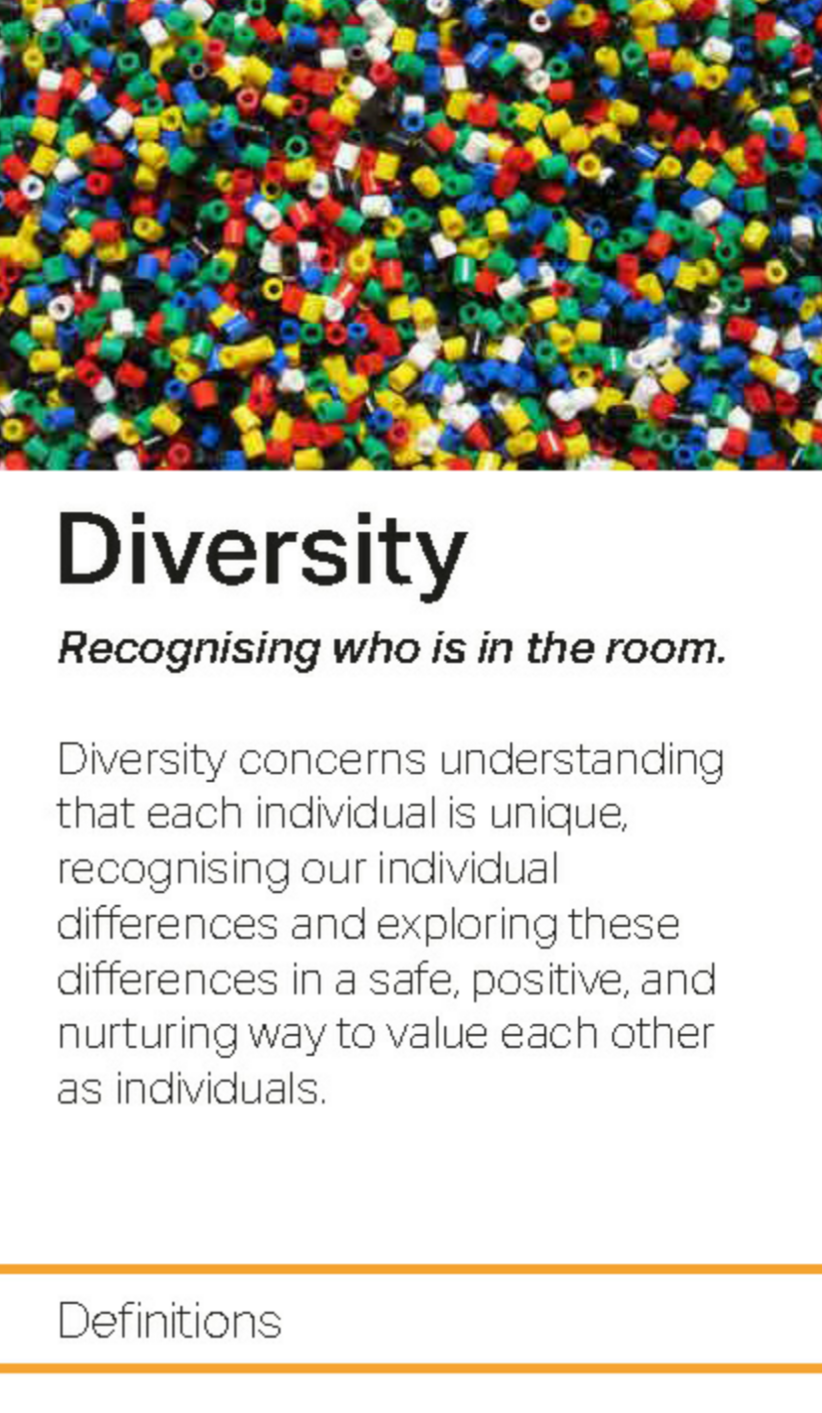
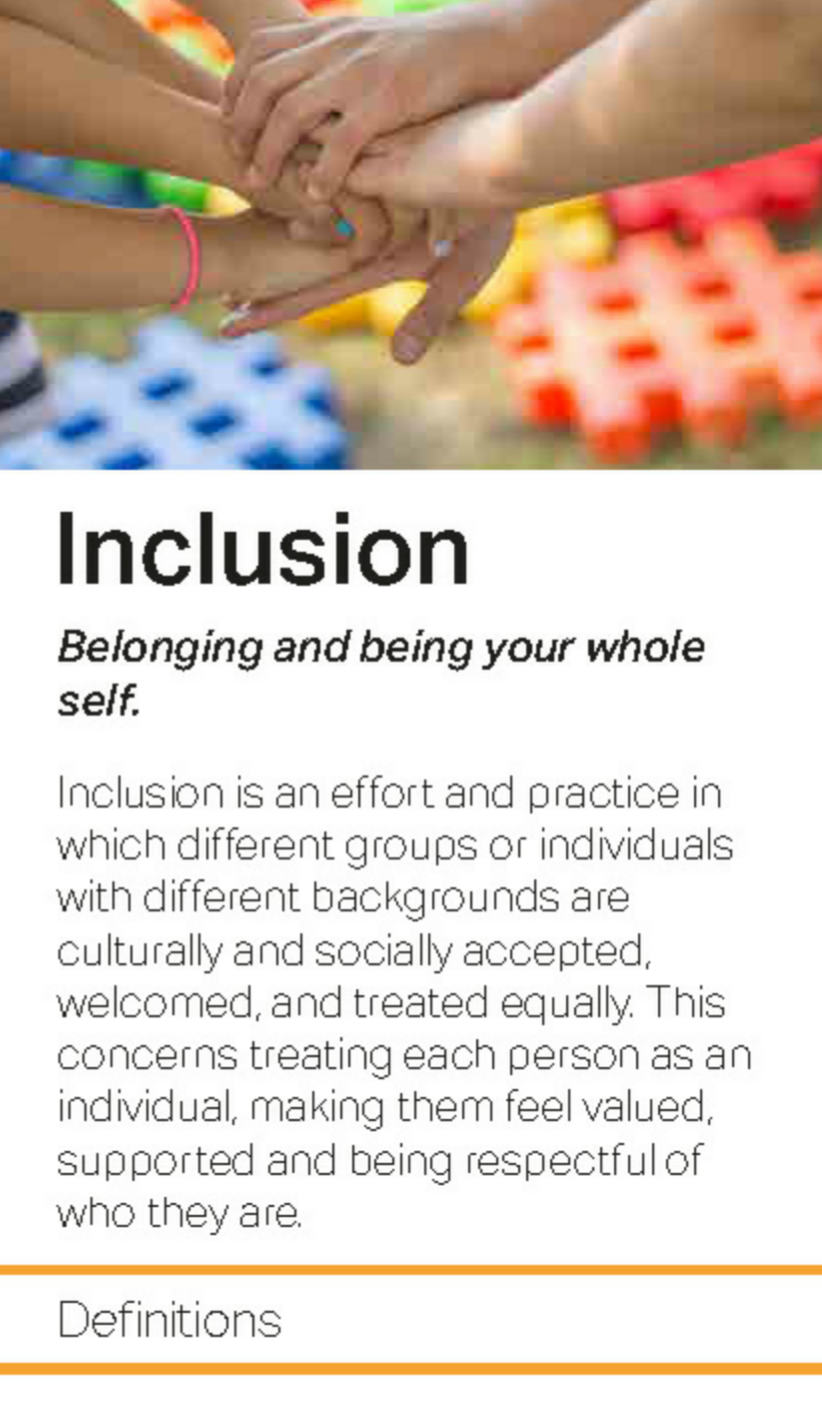
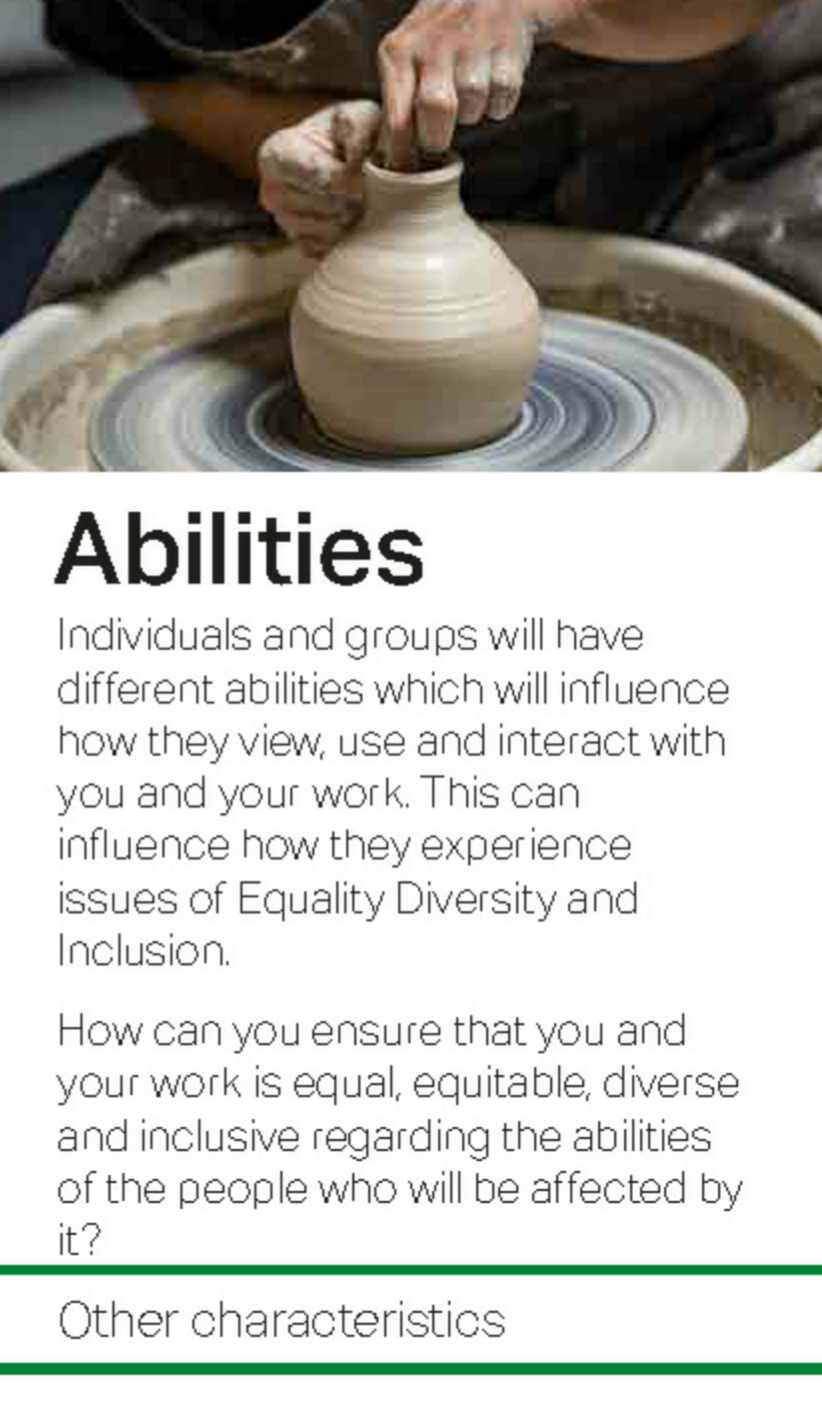
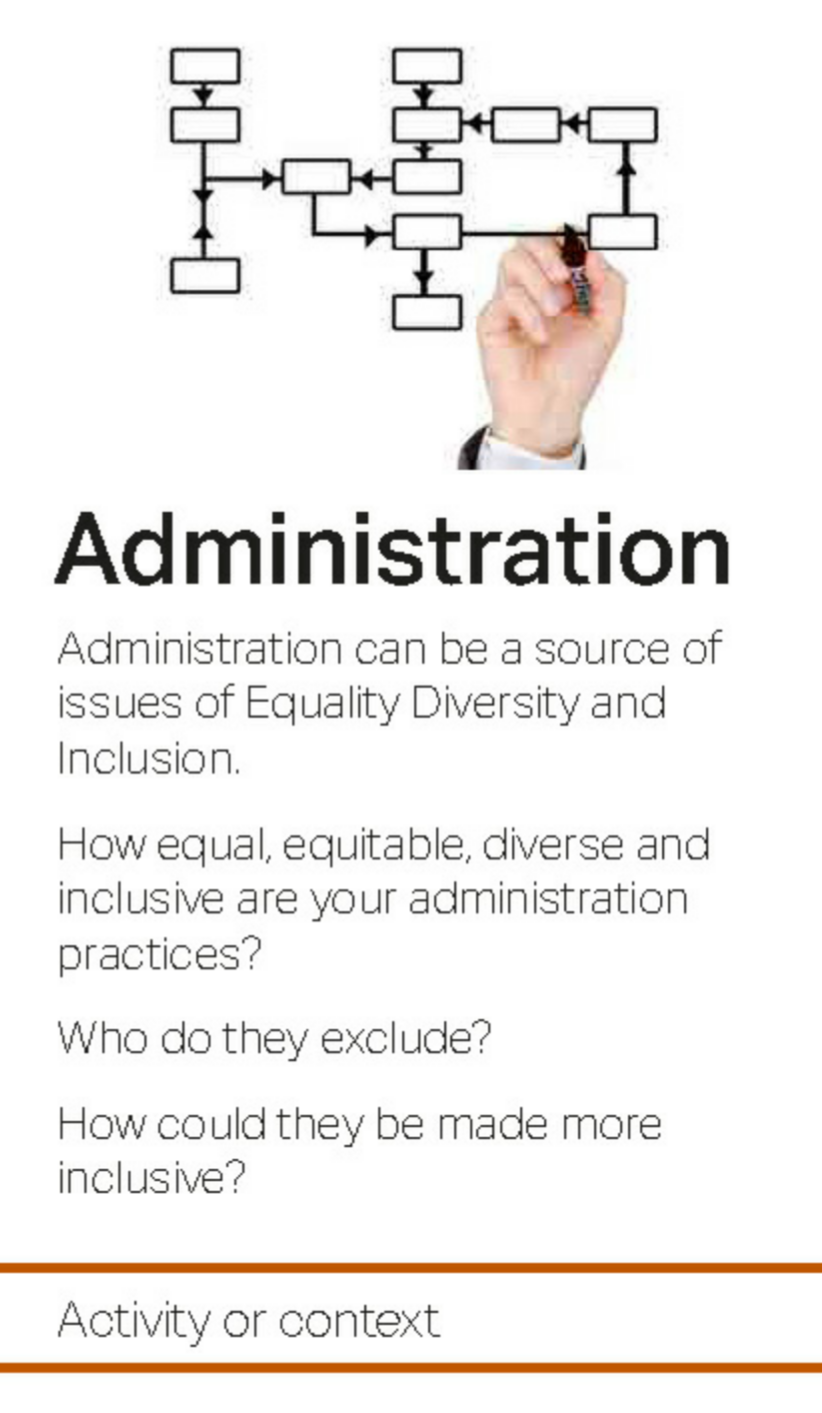
Equality, Diversity and Inclusion (EDI) Cards

They are intended to be used in varied ways to help engagement with elements of EDI to help make work more inclusive. They are underpinned by three questions which they are intended to help people answer

  • How inclusive is my work?
  • Who does it include or exclude and how?
  • How does EDI relate to me and my work?
Issues of Equality, Diversity and Inclusion (EDI) are embedded in and inherent to research and work. They are becoming more prominent with legal requirements, policy aspects and expectations influencing the work of researchers and beyond. Appreciations and understanding of how EDI issues are manifest in work and activities are varied but may not be well appreciated or understood. Considering that work should be as inclusive as possible and greater inclusivity is desirable then the EDI cards are intended to help people appreciate how issues of EDI affect their work. This will hopefully lead to the identification of how inclusivity may be improved, particularly as individuals may be unsure or lack the confidence or experience to do so.

This work was funded by the EPSRC through Connected Everything (grant EP/S036113/1), and UKRI through Horizon Digital Economy (grant EP/T022493/1) and the Future Food Beacon at the University of Nottingham.

Their initial development is described in: Peter Craigon, Debra Fearnshaw, Oliver Fisher, and Emma Hadfield-Hudson. 2023. The Equality, Diversity and Inclusion Cards – Introduction and Work in Progress. In Proceedings of the First International Symposium on Trustworthy Autonomous Systems (TAS ‘23). Association for Computing Machinery, New York, NY, USA, Article 32, 1–7. https://doi.org/10.1145/3597512.3597515

Definitions – To help people understand what is meant by EDI. This theme includes the categories:

  • Definitions,
  • Legal Definitions

Scenario – To help people identify elements of their own work which may contribution to issues of EDI. This theme includes the categories:

  • Protected Characteristics,
  • Other Characteristics,
  • Activity or Context,
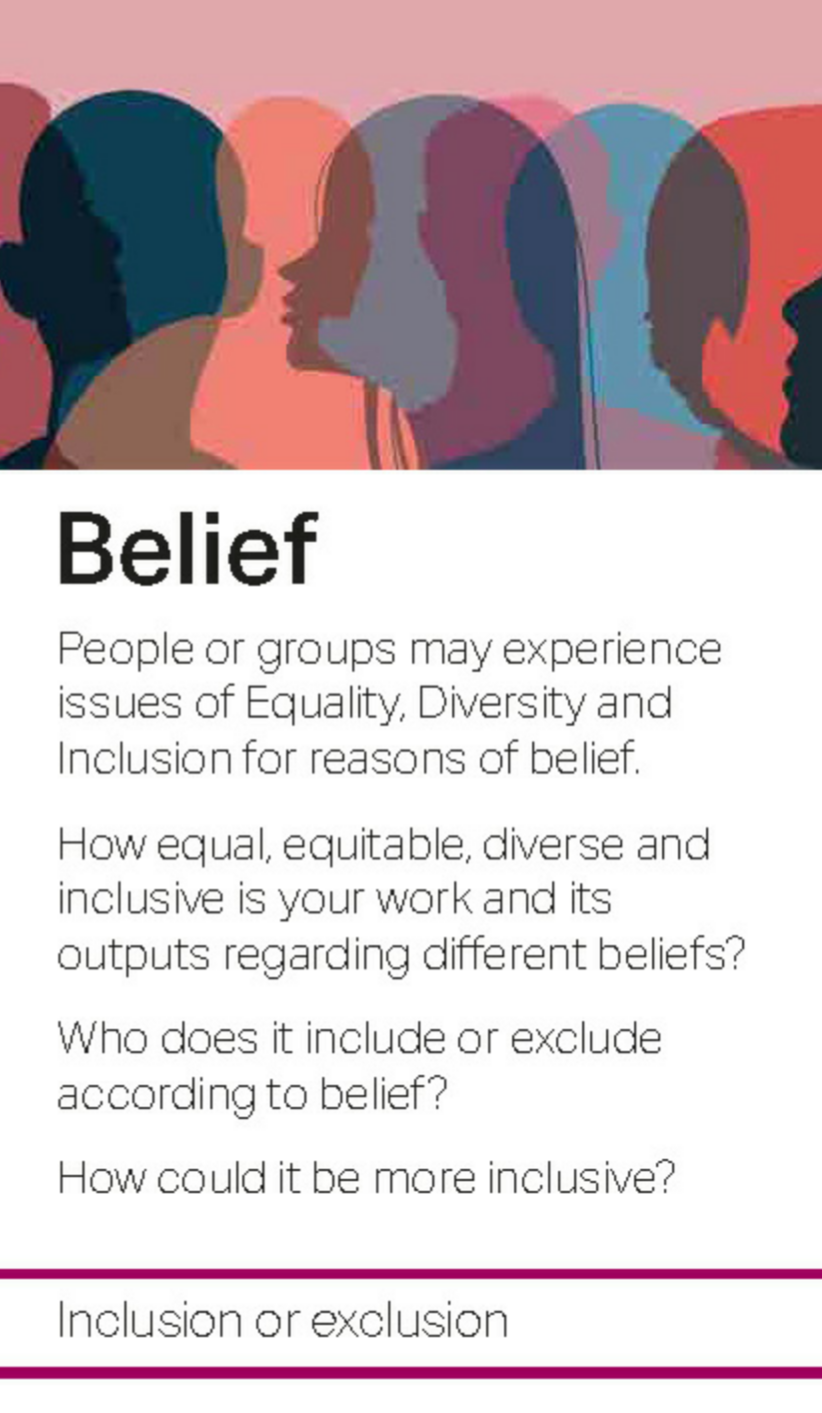
  • Inclusion or Exclusion,
  • Industrial Digital Technologies (included due to the focus of Connected Everything on Digital Manufacturing)

What am I going to do? – To provide a set of examples approaches that could be applied to help improve EDI. This theme includes the categories:

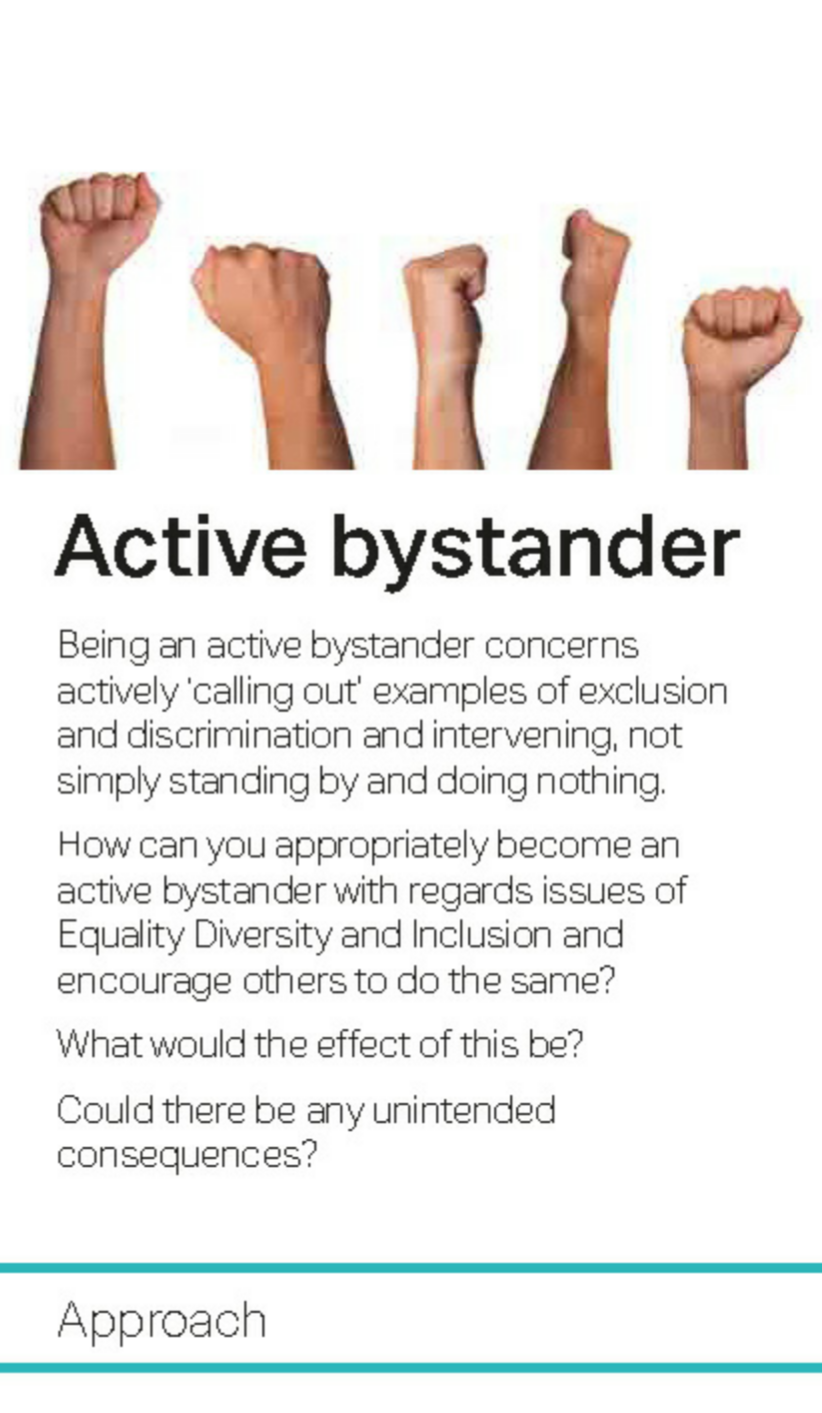
  • Approach,
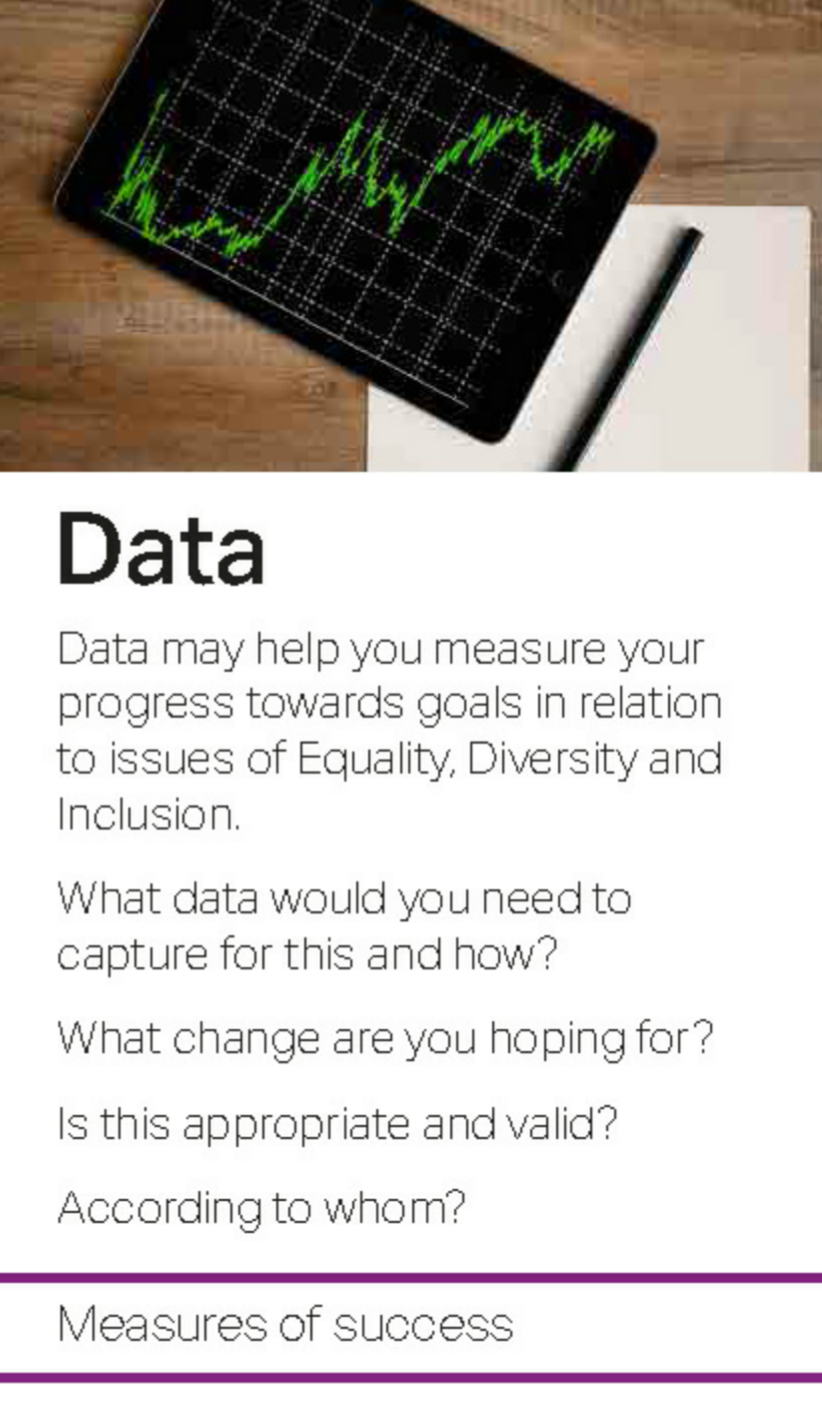
  • Measures of Success

Complications and Practicalities – To help people engage with a range of elements that may complicate efforts to improve issues of EDI. This theme includes the categories:

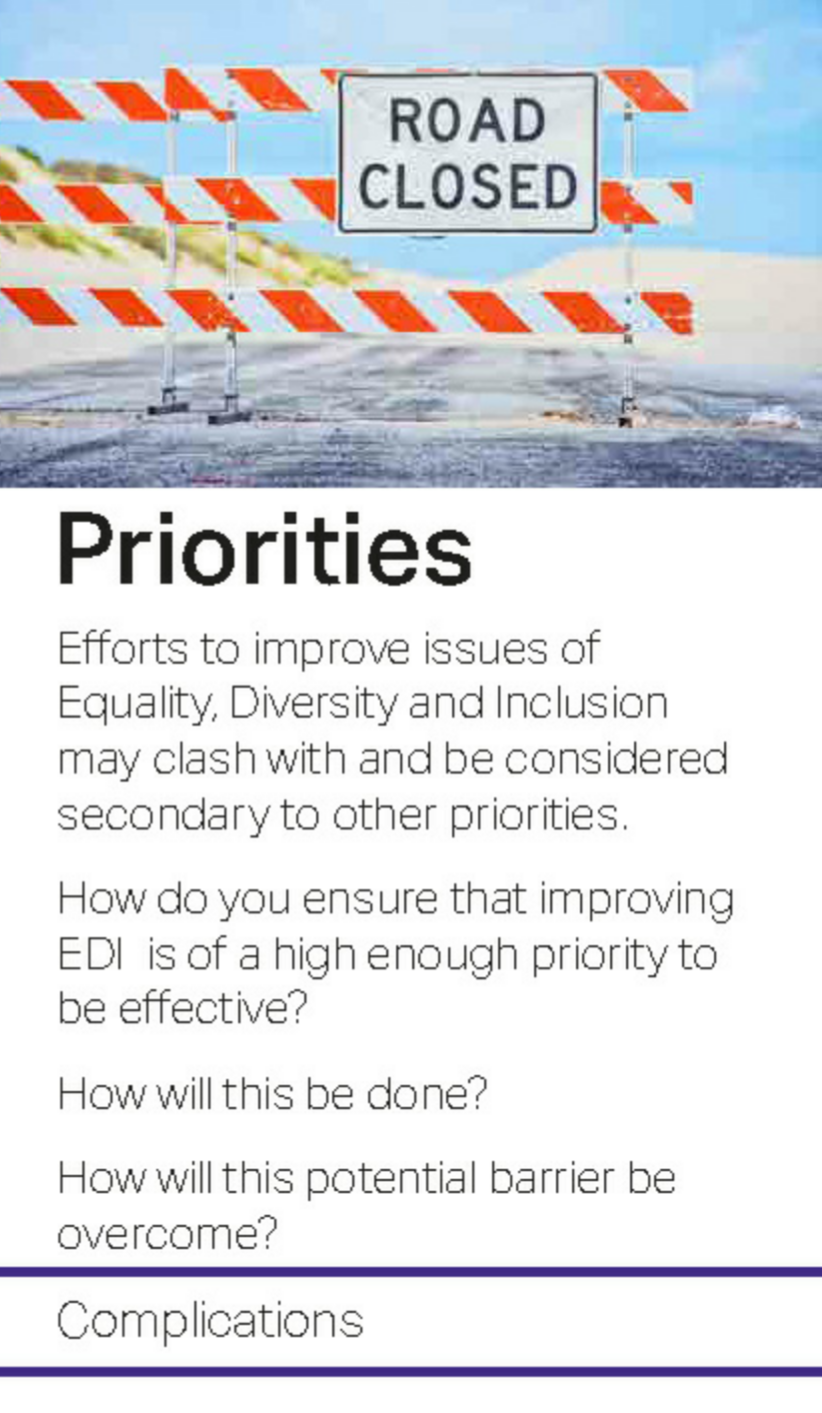
  • Complications,
  • Uncomfortable questions?
  • Digital Manufacturing Challenges (included due to the focus of Connected Everything on Digital Manufacturing)
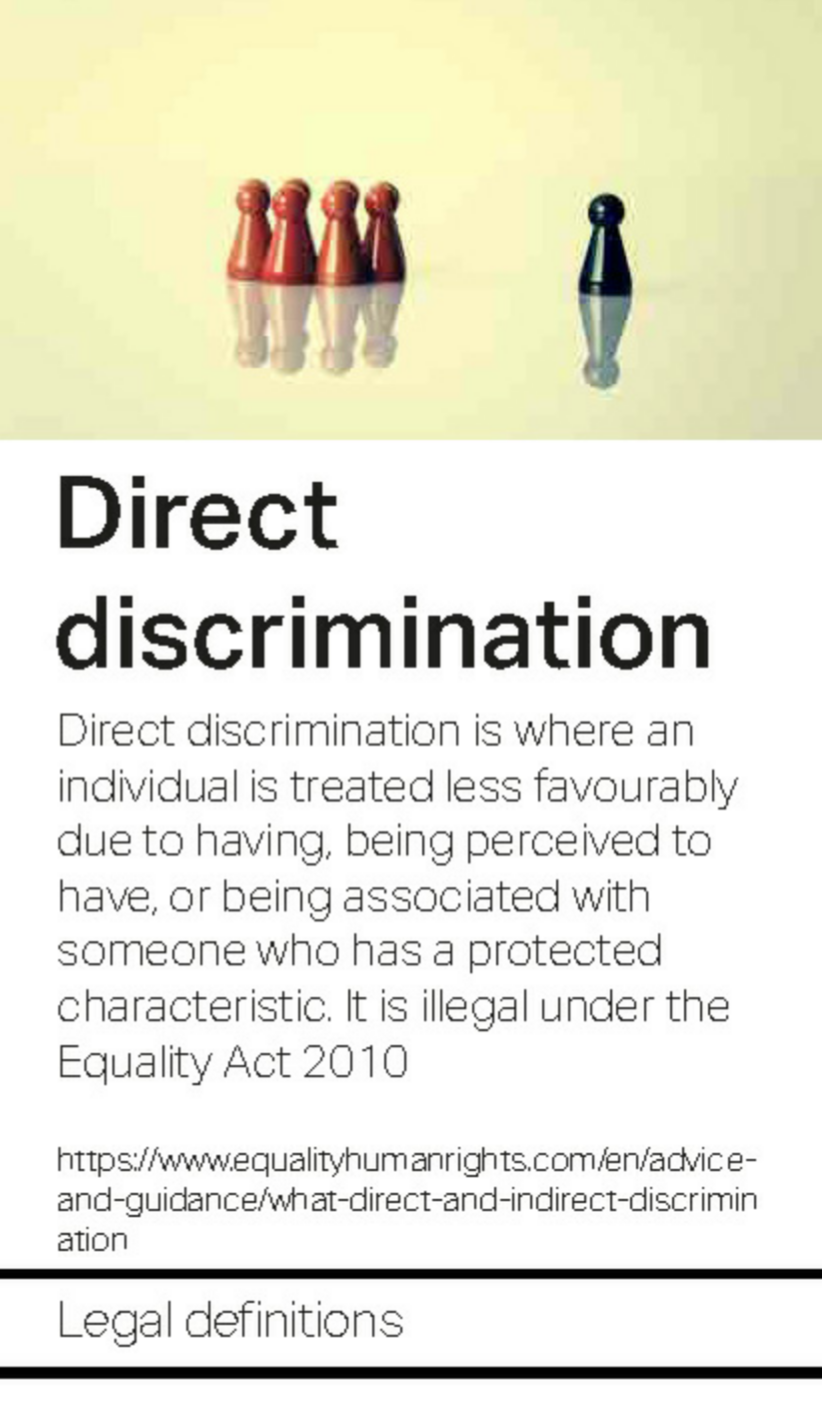
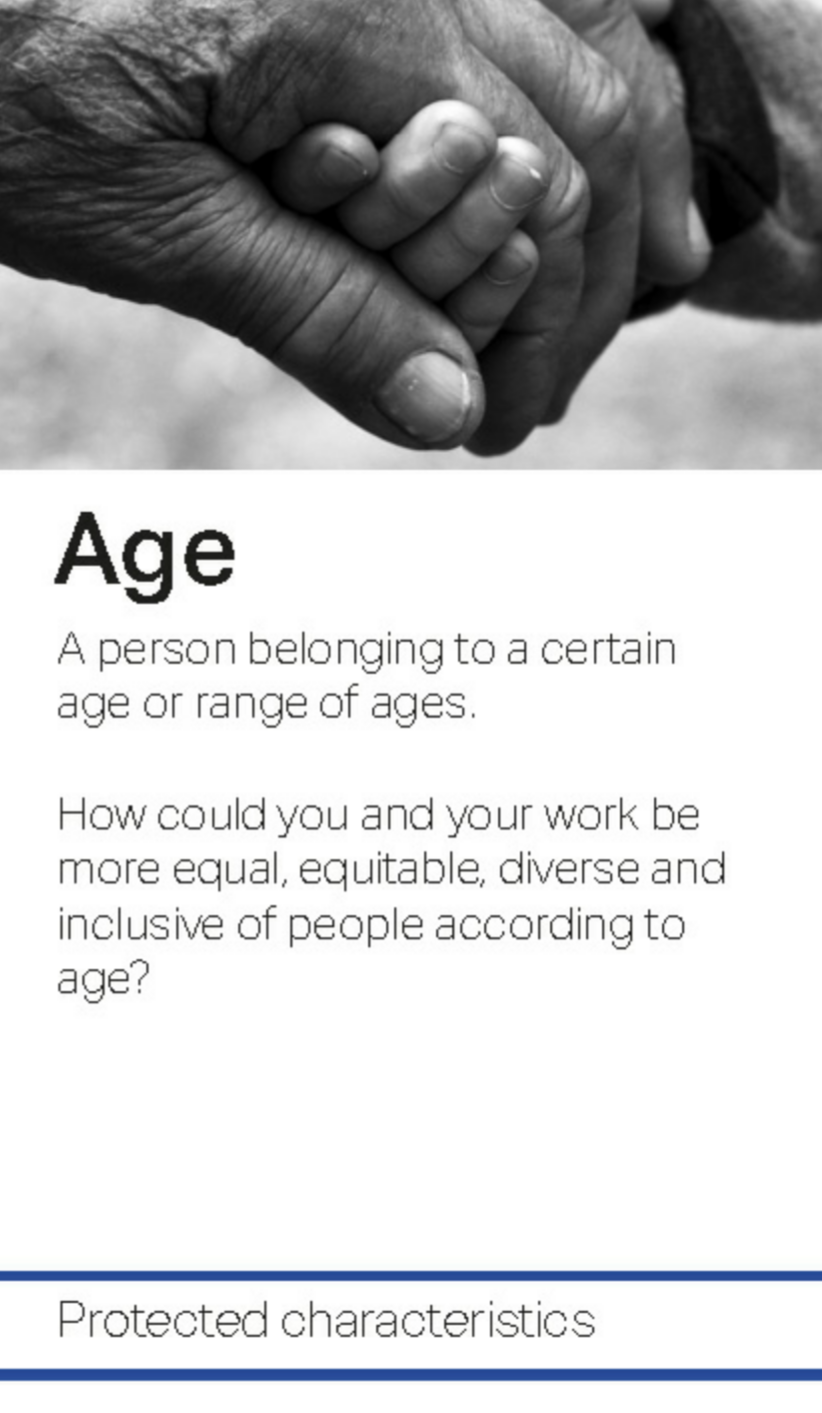
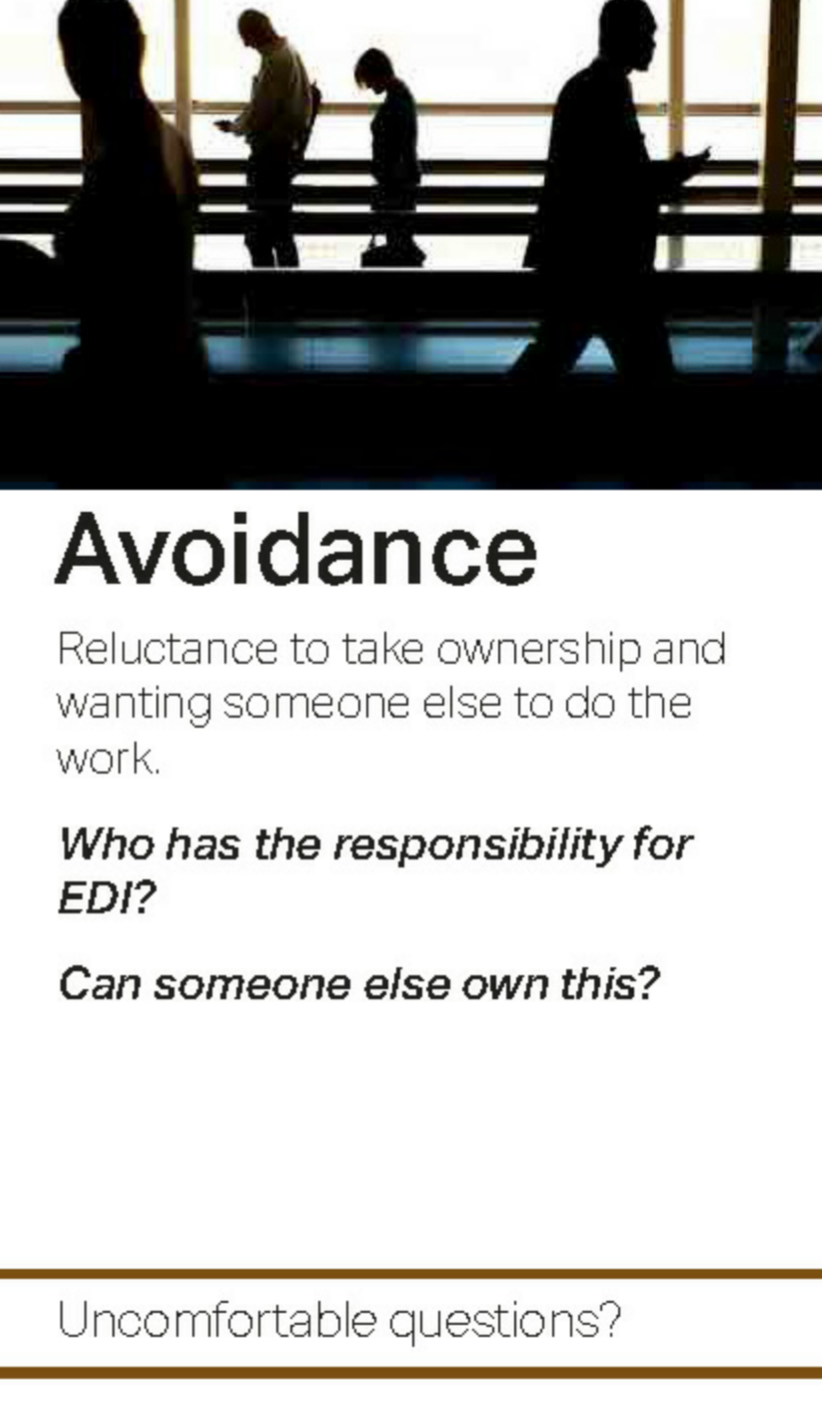
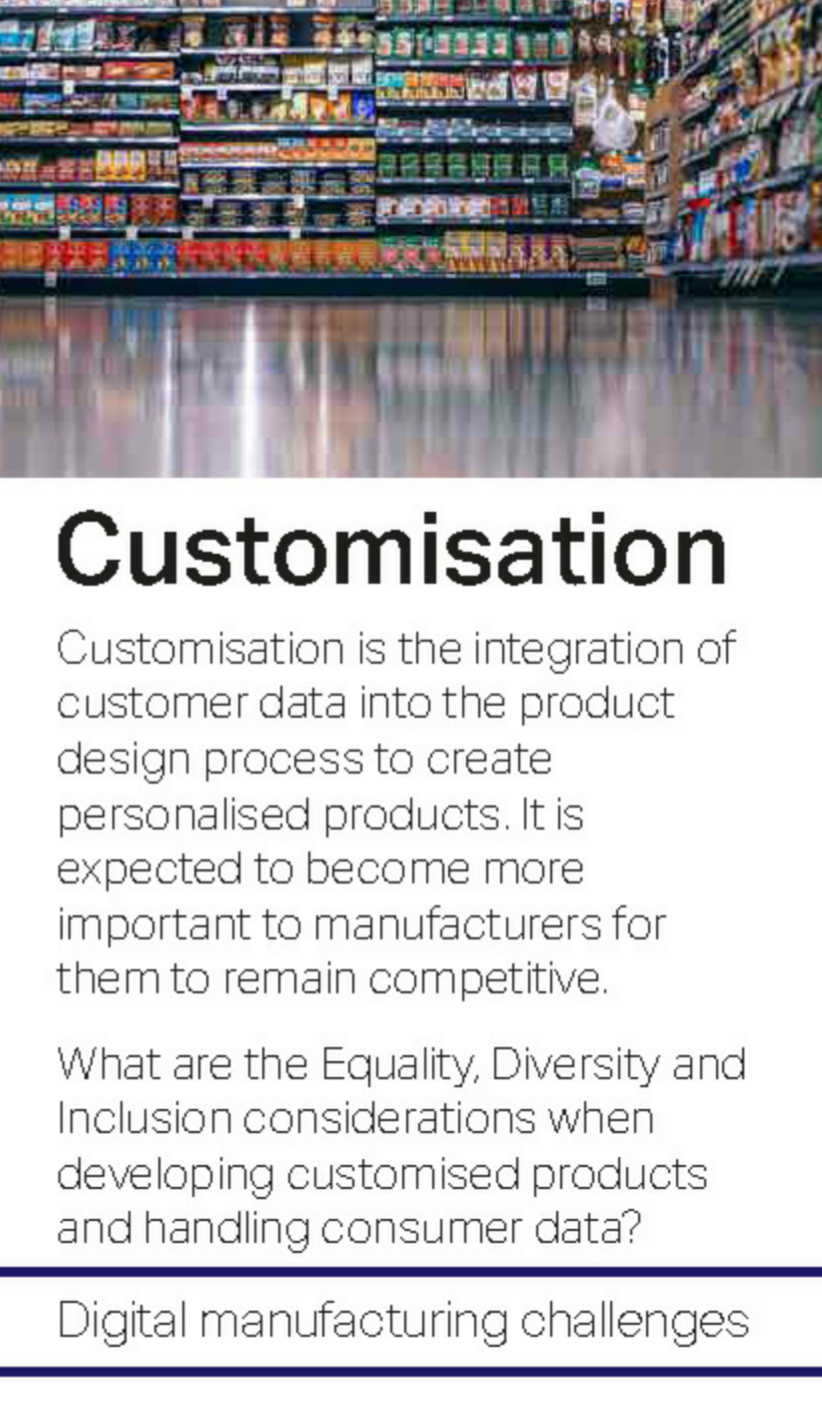
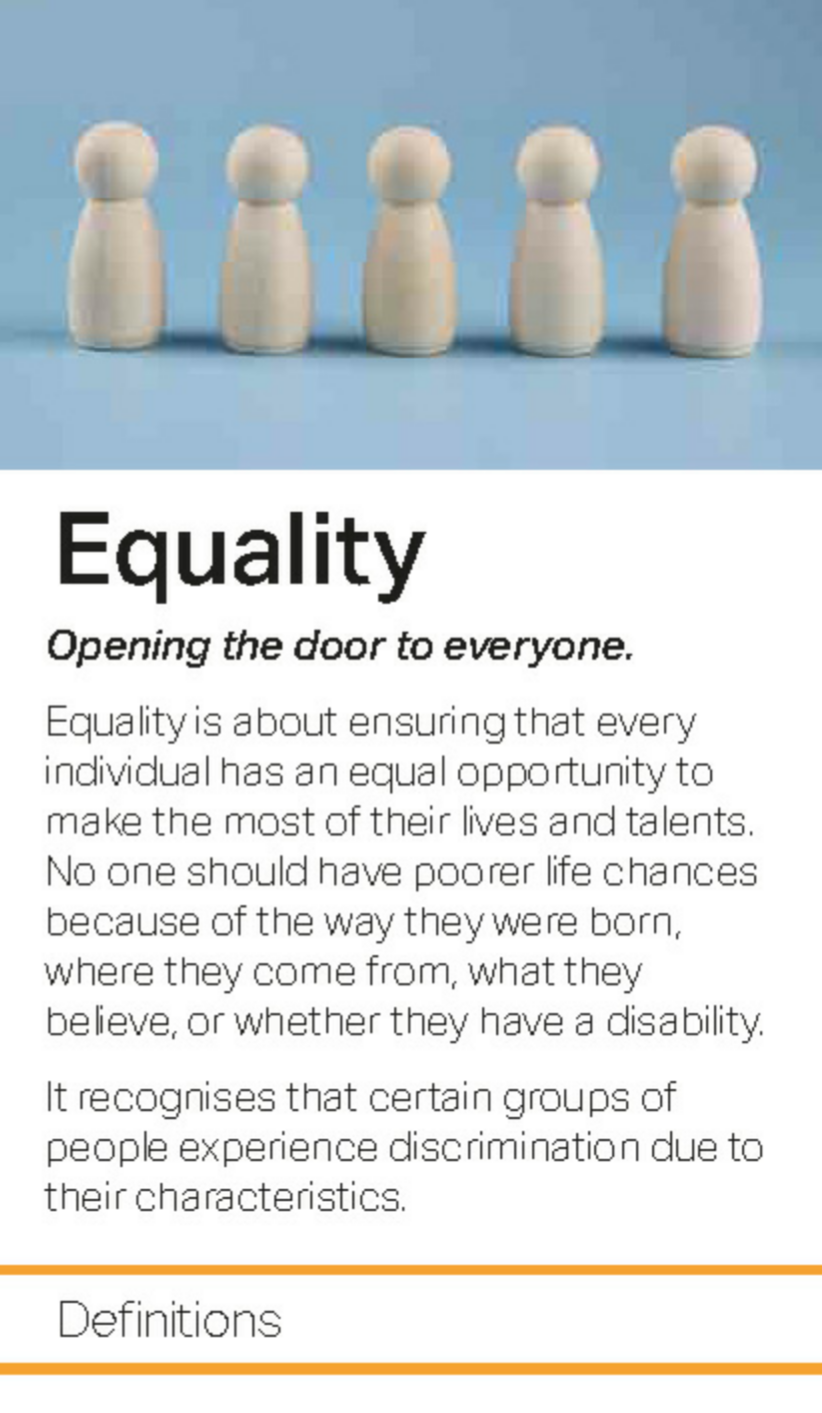
At the top is an image which is intended to illustrate, prompt reflection and potentially provide an alternative perspective on the issue of the card in relation to EDI.

Underneath is the title of the card which identifies the issue the card represents

Underneath a brief explanation of the issues of the card is provided.

Underneath this explanation are open questions which are intended to provoke and promote discussion as to how the issue of the card relates, (or doesn’t) to the work of the users or the focus of discussion.

At the bottom is the name of the category that the card belongs to in between two coloured stripes that match the back of the card.

The back of the card is coloured according to the category of the card with the name of the category at the bottom and the wider theme that ie belongs to at the top. (The guide cards are different with the back identifying the theme of the card and the front providing information to help guide users to develop their own use and activities with the cards)
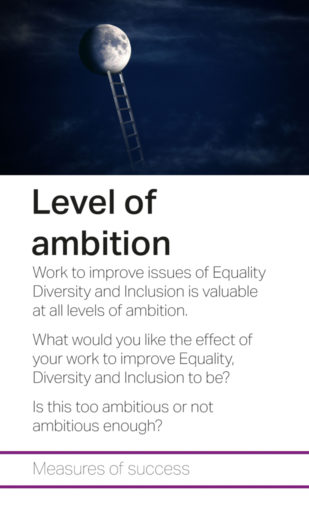
The guide cards provide some suggestions to help you come up with and tailor use of the cards to your own needs and promote productive and respectful discussion. Two approaches we have used that work well are:

Random Draw

  • Pick a card from random and then discuss it, e.g your understanding or experience of it depending on what you are happy to share an discuss.
  • Pick a second card at random (From a different theme) and discuss again but move on to discuss how this new card combines (or doesn’t) with the previous, one selected.
  • Repeat by picking further cards and discuss again how these combine with those previously selected.
  • Continue or repeat.

We have found that drawing combinations of cards at random produces really rich interesting discussions of EDI in (complex) context.

EDI by Design

In relation to a focus, project or piece of work, select cards to identify:

  • EDI positives and negatives of the project,
  • ways of maximising the positives and minimising the negative and
  • complications and practicalities of doing this.

This can be done in advance for EDI by Design to design EDI elements into the work of the project or retrospectively to reflect on a project and how it could be improved in the future for examples.

These include:

See the links below.

From figshare:

We have found Miro a useful tool to enable card sessions to be conducted online and in distributed groups, supported by other tools such as Zoom or Microsoft Teams for example.

A board with the cards and example resources laid out can be viewed at the link to the right/below and a copy of this board can be downloadedfor you to adapt and use for your own purposes can be downloaded from the buttons to the right/below.

This was designed to make cards available more widely online for those without a physical set.

It has been designed to be used on a mobile phone but can also be used via a web browser. You can find the cards at the Link right/beliw or by scanning the QR code to the right/below.

This will be subject to availability and at cost.

Or you can arrange to print them yourself from the PDFs.

The Equality Diversity and Inclusion cards, by Peter Craigon, Oliver Fisher, Debra Fearnshaw, Emma Hadfield-Hudson, Nicholas Watson and Sarah Sharples, the University of Nottingham (2022-2024) are licensed under under a Creative Commons Attribution-Noncommercial 4.0 International license.

Please cite (the cards themselves): Craigon, Peter; Fisher, Oliver; Fearnshaw, Debra; Hadfield-Hudson, Emma; Watson, Nicholas; Sharples, Sarah (2022). VERSION 1.1 - The Equality Diversity and Inclusion cards (updated April 2024). figshare. Online resource. https://doi.org/10.6084/m9.figshare.21222212.v4

Or (their initial development): Peter Craigon, Debra Fearnshaw, Oliver Fisher, and Emma Hadfield-Hudson. 2023. The Equality, Diversity and Inclusion Cards – Introduction and Work in Progress. In Proceedings of the First International Symposium on Trustworthy Autonomous Systems (TAS ‘23). Association for Computing Machinery, New York, NY, USA, Article 32, 1–7. https://doi.org/10.1145/3597512.3597515

Further information is available via the EDI cards pages on the University of Nottingham’s website